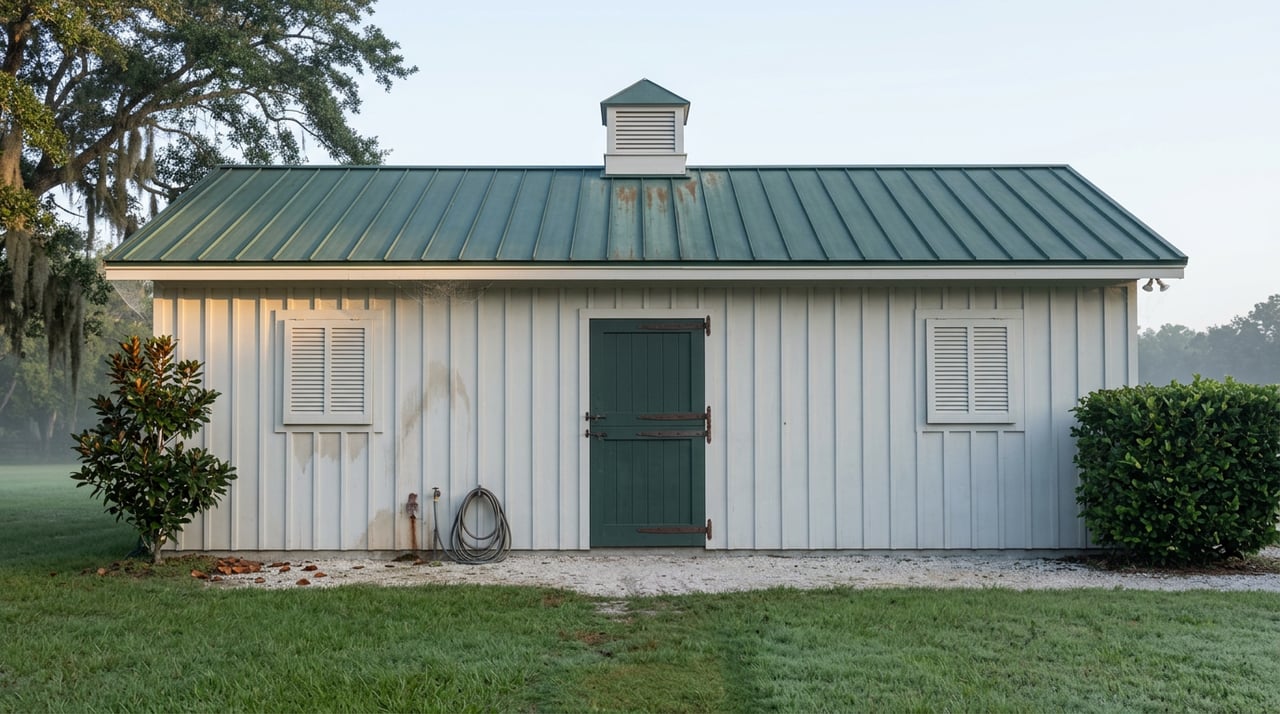
In 2018, Florida's Fourth District Court of Appeal ruled on a case that started with a simple assumption: a Wellington farm owner believed two barns, a storage building, and a manure bin needed no building permits because the land carried an agricultural designation. The Village of Wellington disagreed, issued citations, and the dispute went to a magistrate. The Village won. The order was specific and unforgiving: tear down the second barn. When the farm owner appealed to the Circuit Court of Palm Beach County's 15th Judicial Circuit, the Village's decision held.
That case, 14269 BT, LLC v. Village of Wellington, is worth knowing before you compare two equestrian listings in Wellington's Equestrian Preserve Area, because it points to the thing that actually separates one $4 million barn from another. It is not the acreage. It is not the distance to the show ring. It is whether the structures on that property can prove, on paper, that they qualify for the exemption everyone assumes comes standard with a horse farm.
What "Agricultural Exemption" Actually Waives, and What It Doesn't
Florida law does give real weight to the bona fide agricultural exemption. The same appellate ruling that ordered a Wellington barn demolished also confirmed the broader principle: nonresidential farm buildings, farm fences, and farm signs used for a genuine agricultural purpose are exempt not just from building permits but from zoning regulation itself. That is a meaningful carve-out in a village where the Equestrian Overlay Zoning District governs nearly 9,000 acres.
But the exemption has edges, and Palm Beach County draws them carefully. Claiming it requires a $200 agricultural-exemption review fee, and if the county determines the use does not qualify, the owner is routed back into a standard building permit application with its own fee and timeline. The exemption also does not touch floodplain management rules. A barn built on ag-exempt land in a designated floodplain still has to satisfy Wellington's flood compliance requirements before a certificate of occupancy means anything. None of this shows up in a listing photo of a center-aisle barn with a grooms' apartment. It shows up in the permit file, if there is one.
For a property already built, that means the seller's barn, arena, or storage building may or may not have a clean paper trail behind it. For a buyer planning to add a covered arena or expand stalls, it means the exemption is a starting assumption to verify, not a guarantee to rely on.
Two Neighborhoods, One Assumption Buyers Make Too Fast
Saddle Trail Park and Palm Beach Point are the two names that come up first when a relocating buyer says they want serious acreage inside Wellington's Equestrian Preserve. They read as close cousins: both inside the overlay, both built around bridle access, both priced well into seven figures. Set side by side, the differences that matter are structural, not cosmetic.
| Saddle Trail Park | Palm Beach Point | |
|---|---|---|
| Typical lot size | 1.5 to 4.5+ acres | 5 to 20+ acres |
| Homeowners association | No mandatory HOA | Active HOA |
| Recent market snapshot | Median sale near $4.1 million, about $1,180 per square foot, 272 days on market, roughly 21 months of supply as of late June 2026 | Recent sales commonly clearing well above $6 million, with per-square-foot pricing above $1,600 in 2026 activity |
| Proximity draw | Direct bridle-path access to Wellington International, the Winter Equestrian Festival grounds | Close to the Palm Beach Polo Club and the Palm Beach International Equestrian Center |
| Governance layers | Village Equestrian Overlay only, no association board | Village Equestrian Overlay plus HOA architectural and use review |
The acreage gap explains part of the price gap. It does not explain the governance gap, and that gap is the one buyers tend to skip past.
Saddle Trail Park's lack of a mandatory HOA means there is no association board reviewing barn additions, arena footing changes, or fence line disputes between neighbors. Whatever oversight exists comes from the Village's Equestrian Overlay Zoning District and, where applicable, the Property Appraiser's agricultural classification. Palm Beach Point layers an HOA on top of that same overlay, which means a second set of eyes on architectural changes and, often, a faster path to resolving a boundary or use dispute without going straight to a Village magistrate.
Neither structure is better in the abstract. But a buyer who wants control over what gets built next door is buying something different in Palm Beach Point than in Saddle Trail Park, even if the two properties look nearly identical on paper. And a buyer inheriting a barn with no clear permit history has more exposure in a non-HOA community, where the only backstop is the Village's own enforcement, the same enforcement that ordered a Wellington barn torn down in 2018.
The Paper Trail Worth Asking For Before You Write an Offer
Wellington runs its permitting through an electronic system called ProjectDox, and the Village's own review targets give a sense of how fast, or how slow, a barn question can move once it is raised. Stable permits, both non-residential stables and stables attached to a residence, carry a listed first review target of 10 working days with 4 working days for revisions. Agricultural verification itself is faster, at 3 working days for the initial check and 2 for revisions. Those are review targets for a complete, legible electronic submittal, not the full construction timeline, and an incomplete package resets the clock.
Before an offer goes in on an equestrian property in the Preserve, a buyer's team should be asking for:
- Written confirmation from the Palm Beach County Property Appraiser that the parcel currently carries an agricultural classification, not an assumption based on the seller's description
- Permit history for every barn, arena, and outbuilding on the property, including any structure that predates current ownership
- Documentation of whether any structure was built under the ag exemption and whether that use has changed since
- A floodplain determination for the parcel, since the ag exemption does not waive it
- Recorded HOA documents, if any, covering barn additions, fencing, and animal-keeping rules, or written confirmation that no HOA exists
None of these questions require a specialist to ask. They require knowing that the exemption is a claim to be verified, not a feature that transfers automatically with the deed.
What This Means When Two Barns Look the Same
A buyer comparing a Saddle Trail Park listing to a Palm Beach Point listing is usually comparing acreage, barn count, and distance to the show grounds. Those are the numbers a portal search surfaces first. The number that actually predicts how much friction the next owner will face is buried in a county file: whether the barn on that lot was built as a bona fide agricultural structure, whether that classification still holds, and whether an HOA or the Village itself is the body that will settle the next dispute over it.
The 2018 case did not turn on acreage or price. It turned on whether the structures in question still qualified for an exemption the owner had assumed was permanent. That is the risk sitting inside every equestrian listing in the Preserve, priced the same whether the paperwork is clean or not.
A Few Questions Worth Asking
Does every horse property in Wellington automatically get the agricultural exemption? No. The land has to be classified agricultural by the Property Appraiser and used primarily for a bona fide agricultural purpose, and the county charges a review fee to confirm it. If the use does not qualify, the owner is directed to a standard building permit process instead.
If a community has no mandatory HOA, does that mean there are no rules on barns and fencing? No. The Village's Equestrian Overlay Zoning District still applies regardless of HOA status. What changes without an HOA is who enforces disputes between neighbors, which falls to the Village rather than an association board.
How long does a barn or arena permit typically take to move through Wellington's process? The Village's stated review targets are about 10 working days for a first review on stable permits and 4 working days for revisions, with agricultural verification reviewed faster, in 3 and 2 working days respectively. Those figures apply to complete electronic submittals through the Village's ProjectDox system, not the full construction schedule.
If you are weighing a property in Saddle Trail Park against one in Palm Beach Point, or anywhere else inside Wellington's Equestrian Preserve, the acreage and the price per square foot are the easy numbers to compare. The permit file is the one that actually tells you what you are buying. The Quarles Group works through that file before an offer goes in, not after. Schedule a Consultation to walk through what a specific property's barn history can and cannot tell you.