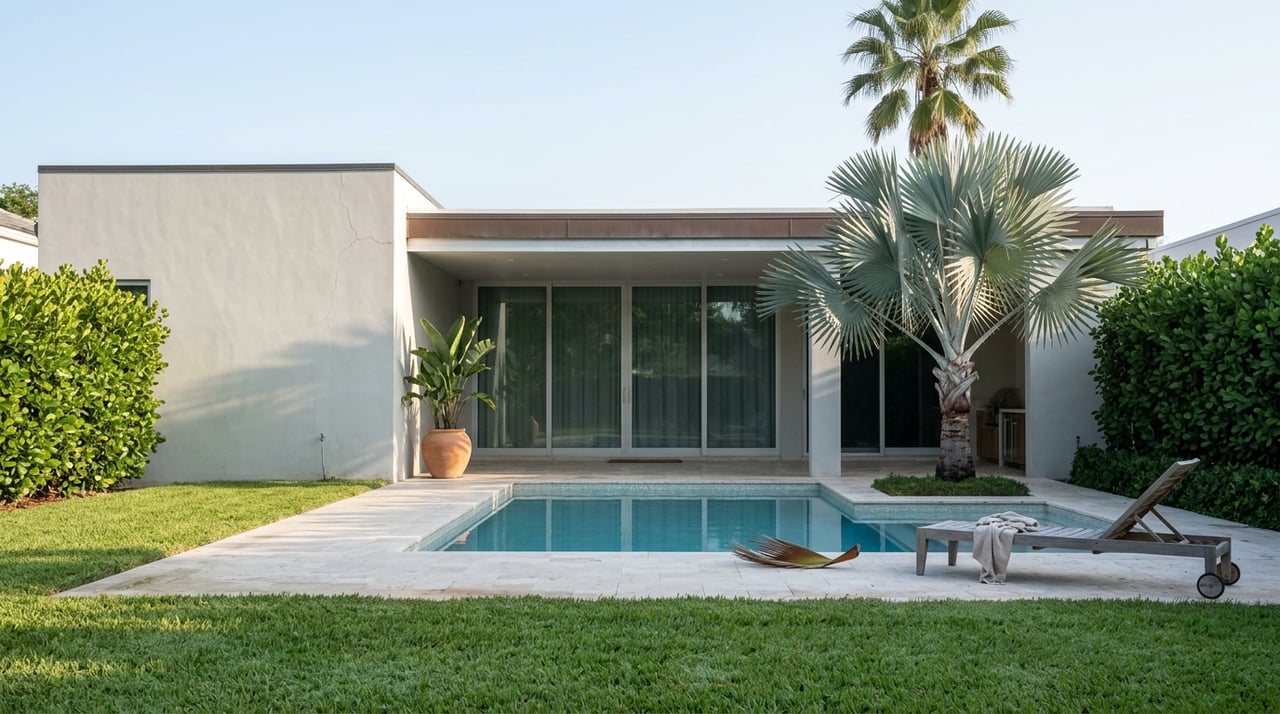
Picture two BallenIsles neighbors on the same street, same floor plan, same course view. One joined the club in 2024. The other joined in the spring of 2025. Neither one thinks much about it until the day they sell. The 2024 member gets back 80 percent of the equity contribution paid at closing. The 2025 member gets back nothing. Same clubhouse, same three championship courses, same monthly bill for years. Completely different outcome at the exit.
The difference reflects BallenIsles' membership terms: equity memberships issued on or after March 1, 2025, provide no refund upon resignation, full stop, regardless of how long the member stayed or how the club performed in the meantime. The club's own strategic planning materials spell this out plainly, and the shift is the clearest illustration of a pattern that runs through nearly every private golf community in Palm Beach Gardens. The number on the listing sheet is not the number that determines what you actually own.
Membership Costs to Compare Across Golf Communities
Most of Palm Beach Gardens' private golf neighborhoods run on some version of mandatory club membership. Buy the house, buy the membership, no exceptions. Old Palm requires a $175,000 equity contribution at closing plus roughly $22,000 in annual dues. Frenchman's Creek runs a single membership category across all 606 households, with a $300,000 refundable equity contribution and annual dues that ran $48,572 under its most recently published schedule, covering May 2024 through April 2025. BallenIsles ties membership to homeownership across its 33 neighborhoods and roughly 1,575 residences, with categories spanning Full Golf, Sports, Tennis, and Social/Fitness.
PGA National breaks the pattern. Membership there is not automatically bundled with the deed. Buyers can own a home in several PGA National neighborhoods without ever joining the club, which means two houses priced within a few thousand dollars of each other, one inside a mandatory club and one outside it, can carry entirely different total costs of ownership before either buyer signs a single membership form.
This is the variable that a median price or a per-square-foot comparison cannot show you. A community's sale prices tell you what buyers paid for the home; they do not include the separate costs associated with club membership.
| Community | Membership structure | Mandatory at purchase | What happens at resale |
|---|---|---|---|
| Old Palm | Equity, single category | Yes | 80% of equity contribution refundable |
| BallenIsles | Equity, multiple categories | Yes | 80% refund for memberships issued before March 1, 2025; no refund for memberships issued on or after that date |
| Frenchman's Creek | Equity, single category, no outside members | Yes | Refundable equity (percentage confirmed at membership office) |
| PGA National | Varies by neighborhood | No, in several neighborhoods | Not applicable where membership is optional |
| Panther National | Invitation-only, minimum Social Membership required | Yes, at least one tier | Terms confirmed at sales center; initiation reduced for property owners |
| Old Marsh | Invitation-only, non-equity, capped at 279 members | Not tied to homeownership | Non-equity, no resale refund structure |
What Changed at BallenIsles, and Why It Matters Beyond BallenIsles
The March 2025 change at BallenIsles shows why buyers should check the membership terms that apply to a specific home. For years, the club's fee schedule promised members 80 percent of their equity contribution back when they sold. That figure showed up in listing conversations, in buyer math, in the assumption that a six-figure membership was at least partly recoverable. The club's updated materials now draw a hard line at membership issue date. Anyone joining on or after March 1, 2025 forfeits the refund entirely upon resignation, and the club can also deduct any outstanding charges from whatever balance a resigned member is owed before that balance is even calculated.
For a buyer comparing two BallenIsles resales today, this means the membership attached to a given house is not a fixed asset. It is a date-stamped contract, and the date matters as much as the price. A seller who joined in 2023 is offering a membership with real resale value built in. A seller who joined in 2025 is offering one that functions closer to a sunk cost, no different from a country club initiation fee that vanishes the moment you sign it away.
This is not a BallenIsles quirk. It is a preview of how equity club terms move. Boards revise fee schedules to manage capital needs, course renovations, and clubhouse projects, and those revisions apply going forward, not retroactively. Any buyer treating a club's membership refund policy as a fixed, guaranteed number is working from an assumption the club itself can change with a board vote.
Why the Old Palm Math Doesn't Stay in the Old Palm Price Range
It is tempting to file all of this under "ultra luxury problem." Old Palm's average sale price runs around $5.8 million, and its $175,000 equity contribution plus $22,000 in annual dues can push the true annual carrying cost on that average home past $200,000 once property taxes, the community development district assessment, insurance, and HOA fees are layered in. That math is easy to write off as a rarefied concern for buyers already spending eight figures on a house.
But the same mechanism operates at every price point where mandatory membership applies. Frenchman's Creek's $300,000 equity contribution and $48,572 in annual dues sit on top of whatever the home itself costs, and because Frenchman's Creek runs a single membership category with no outside members permitted, there is no lower tier to soften that number for a buyer hoping to spend less on the club side. BallenIsles offers more flexibility through its Sports, Tennis, and Social/Fitness categories, but a buyer who assumes those categories cost meaningfully less than Full Golf, or who assumes the equity portion behaves the same way it did for a neighbor who joined two years earlier, is comparing homes on the wrong axis.
The lesson is not that mandatory-membership communities are a bad deal. Many buyers want exactly what these clubs offer and view the membership as part of the purchase, not an obstacle to it. The lesson is that the sale price alone cannot tell you whether a $2 million home in one club community actually costs less to own than a $2.3 million home in another, because the membership terms, not the square footage, are doing most of the work in that comparison.
The Newest Number in the Comparison Set
Panther National adds a fresh variable to this math, and it arrived recently enough that most buyer comparisons in the market have not caught up to it yet. Ohana Real Estate Investors acquired the community from its previous ownership group in July 2026, taking on a 400-acre property built around an 18-hole championship course designed by Jack Nicklaus and Justin Thomas. The club's clubhouse, at nearly 60,000 square feet, is targeted to open in fall 2026, which means buyers today are purchasing into a community whose full amenity picture is still being built out rather than already complete.
Panther National's structure requires every unit purchaser to obtain at least a Social Membership, with a Resident Golf Membership available on top of that, and initiation for the golf tier runs $500,000, reduced to $400,000 for property owners. That reduction itself is a signal worth noticing. The club is pricing membership differently depending on whether you already own real estate there, which means the true cost of joining depends on the order in which you make your decisions, not just which tier you choose.
For a buyer weighing Panther National against an established club like BallenIsles or Old Palm, the comparison now includes a variable none of the legacy communities carry: an amenity roadmap that is still in progress under new ownership. That is not a reason to avoid it. It is a reason to ask different questions than the ones that apply to a fully built clubhouse that has operated under the same terms for a decade.
Before You Write the Offer
A handful of questions separate buyers who understand what they are actually purchasing from those who find out after closing:
- Is club membership mandatory with this specific property, or does it vary by neighborhood within the community, as it does at PGA National?
- If membership is equity-based, what is the refund percentage, and when was the current membership issued? A club's stated refund policy may not apply to memberships issued after a certain date, as it no longer does at BallenIsles for anything issued on or after March 1, 2025.
- What is the full annual carrying cost once equity or initiation costs are amortized, dues, HOA or POA fees, community development district assessments, and any food and beverage minimums are added together, not just the headline dues figure?
- If the community is still building out amenities, as Panther National is through 2026, what is actually open today versus what is projected, and does the purchase contract tie any pricing incentive to timing?
- Are the membership terms recorded in the deed or covenants, meaning they transfer with the property regardless of what the current owner negotiated, or are they set at the club level and subject to change for future members?
These questions require looking beyond a portal search. Check with the membership office and review the HOA documents and fee schedule before making an offer.
Comparing Palm Beach Gardens golf communities on price alone tells you which house costs more. It does not tell you which purchase costs more, and in this market those are frequently two different numbers.
If you are weighing a golf community purchase in Palm Beach Gardens and want a clear read on what the membership behind a specific listing actually requires, The Quarles Group can walk through the full cost picture with you before you write an offer. Schedule a consultation and bring your list of communities.
This article is general information, not legal, tax or financial advice. Consult a qualified professional about your situation.